Sold Over Asking
The Problem With “Sold Over Asking”
Sold Over Asking Wasn’t the Problem. The Lie Was.
Estimated read time: 8:30 minutes
There is a line I refused to cross. This article may ruffle a few feathers, but I think it is worth saying plainly.
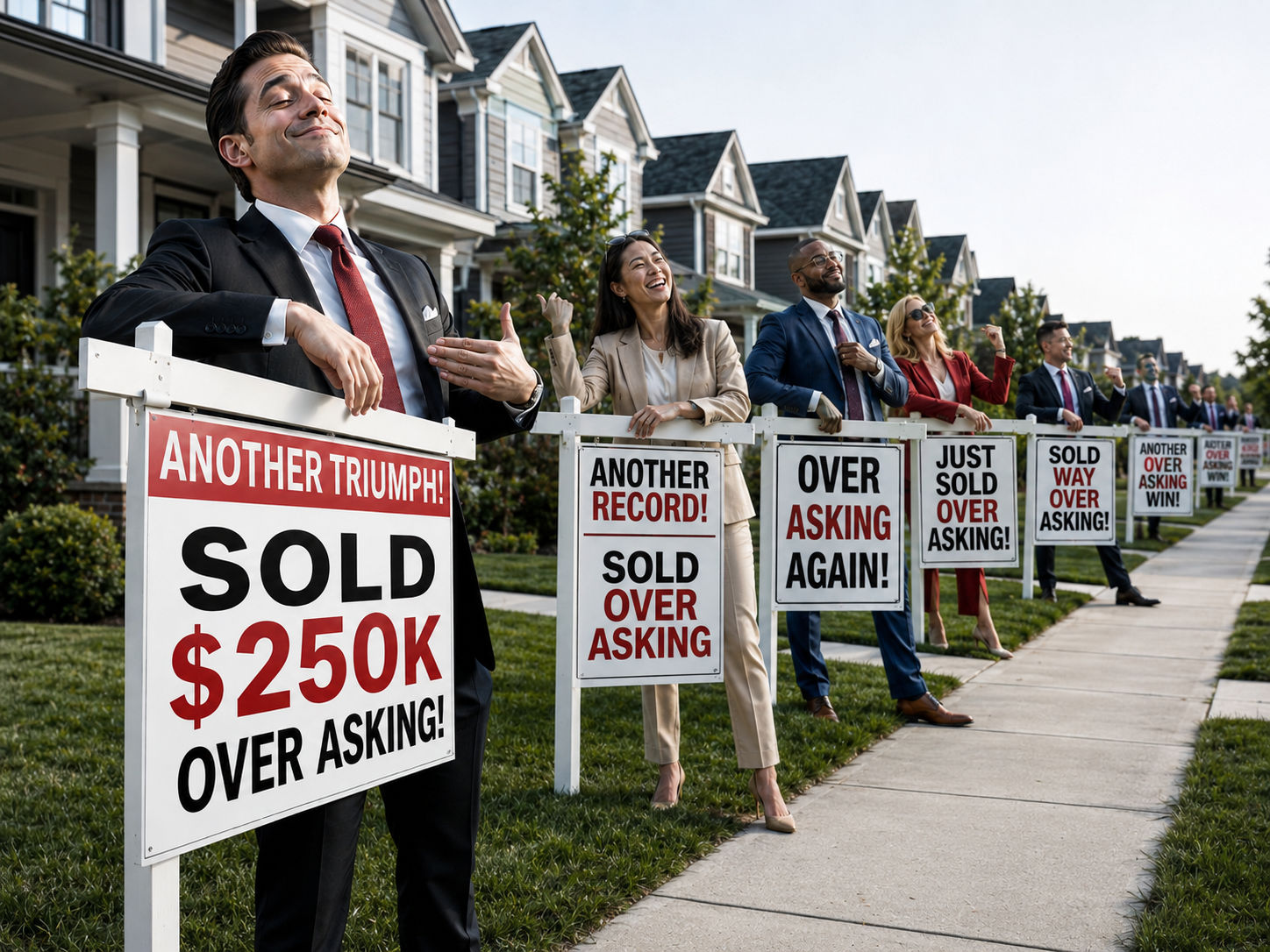
During the peak years of the market, “sold over asking” became one of the most abused phrases in real estate. It showed up on signs, postcards, social media posts, email blasts, agent videos, and just about every other form of self-promotion available. Sold $200,000 over asking. Sold $500,000 over asking. Sold $1,000,000 over asking. The public was supposed to believe this was proof of exceptional skill. In many cases, it was not. In many cases, the property had been deliberately listed below market value in the first place.
I was not against underpricing. In that market, underpricing was often the correct strategy. Prices were moving quickly. Buyer behaviour was emotional. Inventory was tight. “Market value” was not always a clean, exact number. It was often a range. A house that might reasonably sell between $1,000,000 and $1,250,000 in Toronto could easily be listed at $999,900. A house that might reasonably sell between $1,250,000 and $1,500,000 might be listed around $1,199,000. That was not automatically dishonest. That was how the market was functioning.
The problem was not the pricing strategy. The problem was what some agents did after the sale. They took a predictable result from a deliberately low list price and marketed it as if they had personally created hundreds of thousands of dollars in extra value. That was the lie too many people became far too comfortable telling.
The Market Did Not Need More Ego
There were years where the market itself was doing a tremendous amount of the heavy lifting. If a good house was priced strategically, presented reasonably well, and exposed to the open market, there was a strong chance it would sell with multiple offers. That does not mean the agent did nothing. Agents still had an important job to do: protect the seller’s interests, prepare the property properly, expose it well, manage the process, and help the seller make strong decisions under pressure.
The job was not to take the predictable forces of a hot market and turn them into a trophy for ourselves. Week after week, agents paraded “sold over asking” numbers as if those numbers proved personal brilliance, even when the asking price was never intended to represent market value in the first place. That is what made it so insulting, not only to the public, but to the profession.

Next in the Series
Can Your Realtor Afford to Tell You No?
A "sold over asking" result might make for impressive marketing, but it doesn't necessarily tell you much about the quality of advice behind the transaction.
That raises a more uncomfortable question: What happens when the best advice a Realtor can give is not to buy, not to sell, or simply to wait?
Real estate is a business built around transactions. But good advice doesn't always lead to one. That tension is worth understanding, particularly when financial pressures and business models can influence how freely an agent can recommend doing nothing.
In the next article, I explore why a Realtor's ability to say "no" may tell you more about their professional judgment than the number of homes they've sold.
Buyers Were Already Struggling
This is the part that bothered me the most. Buyers were already exhausted. They were losing offer after offer. They were stretching budgets. They were trying to understand why a house listed at one number would sell for hundreds of thousands more. They were trying to figure out what “affordable” even meant anymore. In the middle of that, some agents were publicly celebrating the very thing that made the process feel impossible: another record sale, another bidding war, another massive number splashed across social media.
I understand celebrating a good result for a client. I understand being proud of your work. There is still a difference between communicating results and turning buyer frustration into your personal marketing campaign. At its worst, it was callous toward the very consumers our industry claims to serve. Real estate is not supposed to be a sport where buyers are the losing team and agents get to celebrate the scoreboard. These were people trying to buy homes: families, first-time buyers, move-up buyers, and people making enormous financial decisions in a market that already felt out of control.
I Refused to Do It
I did not do that. I refused. Not because I was above the market. I was working in the same market as everyone else. I used strategic pricing when it made sense. I understood the patterns. I understood why a property might be listed below its expected sale range. I understood offer dates, buyer psychology, and market momentum.
What I would not do was take an artificially low list price and pretend the final sale price was proof of my greatness. That crossed a line for me. It felt misleading. It felt careless. It felt like an insult to the intelligence of the public. If a house was worth somewhere around $1,500,000 and someone listed it at $699,000, then bragging that it sold hundreds of thousands over asking was not impressive. It was theatre. It was marketing built on a number that never meant what the public was being encouraged to think it meant.
The Real Work Was Somewhere Else
In a hot market, the real question was not whether a good house could sell. Many could. The real question was whether the agent still did the work properly.
Too many agents, in my opinion, took the strength of the market for granted. Some lowered their own costs because they knew the property would probably sell anyway. They skipped proper preparation, professional photography, accurate floor plans, key documents, pre-inspection reports where appropriate, and clear information about the home’s systems, improvements, warranties, surveys, utilities, and carrying costs.
They also ignored the smaller details buyers notice immediately: chipped paint, loose handles, poor lighting, tired caulking, broken trim, neglected landscaping, and the little signs that say, fairly or unfairly, “this house has not been cared for.” Maybe the house still sold. That does not mean the job was done well.
Presentation is not just about making a house look pretty. It is about trust. When buyers walk into a home that has been prepared, documented, and explained properly, they feel the difference. They feel that the seller cared, that the agent cared, and that the home was not simply thrown onto the market with a low price and a prayer.
That was a chunk of my job: to present the property in its best honest light, protect the seller, respect the buyer, and make sure the strength of the market did not become an excuse to get lazy.
Where Was the Accountability?
This is also where I think the industry needs to be honest with itself. Where was the accountability? Where was the serious conversation about how misleading this had become? The public was being bombarded with marketing that made “sold over asking” look like a meaningful measurement of agent skill, while many people inside the industry knew the number was often manufactured by the list price itself.
That should have bothered more people. It should have bothered brokerages. It should have bothered regulators. It should have bothered any Realtor who cared about public trust in the profession. I also need to be honest about the position working agents were in at the time. I did not want my name associated with this kind of marketing, but I could not simply shout about it publicly while it was happening. My clients still needed me to cooperate with other agents. They needed me to negotiate with them, communicate with them, and maintain enough professional respect to protect their interests.
That is not an excuse for the behaviour. It is an explanation of the practical reality. This is one of the reasons the regulator mattered so much. Individual agents had to keep functioning inside the marketplace. The regulator had the authority, distance, and responsibility to step in and say: this is misleading, this is damaging public trust, and this needs to stop.
They did not.
Maybe it was not always technically false. Maybe it was not always easy to regulate. Maybe the wording could be defended in a narrow sense. Ethics should not only be about what you can get away with.
What Should the Public Ask?
There are tens of thousands of real estate agents. For the public, it can be very difficult to know who is actually skilled. Sales awards do not tell the whole story. Social media does not tell the whole story. A polished video does not tell the whole story. A “sold over asking” sign definitely does not tell the whole story.
Maybe one of the questions consumers should ask is this: when the market made it easy to look successful, what did that agent do with it? Did they stay grounded? Did they keep doing the work? Did they respect buyers, even in a seller’s market? Did they tell the truth about what was really happening? Or did they take an artificial list price, slap “sold over asking” on a sign, and pretend the gap was proof of their brilliance? That may sound like low-hanging fruit, but sometimes low-hanging fruit tells you a lot.
The Line I Would Not Cross
I am not writing this because I think every agent who ever used the phrase “sold over asking” did something wrong. Context matters. Pricing strategy matters. Markets matter. I am saying there was a version of that marketing that became deeply misleading. It became far too common. It was silly. It was insulting. At its worst, it was callous toward the very consumers our industry claims to serve.
I did not want my name attached to that. I did not want my value to come from pretending the market’s momentum was my personal achievement. I wanted my value to come from doing the work properly: preparing the property, protecting the seller, respecting the buyer, explaining the details, understanding the strategy, and telling the truth about what was actually happening.
That is the kind of line I think consumers should care about. The next time the market makes it easy for agents to look good, the question should not be who can shout the loudest. The question should be who still has the discipline, humility, and ethics to do the job properly.
Also Worth Reading
If this article has you thinking more carefully about Realtor value, another related question is worth exploring: why fear-based or shame-based real estate marketing should make consumers pause.
Related Reading: Where This Conversation Started
This broader discussion grew out of a smaller but important contract issue involving a missed hot water tank rental in an Agreement of Purchase and Sale. The details matter, but the bigger lesson is about judgment, fairness, and how people respond when something goes wrong.
