Other Side of the Water Tank argument
The Other Side of the Water Tank Argument
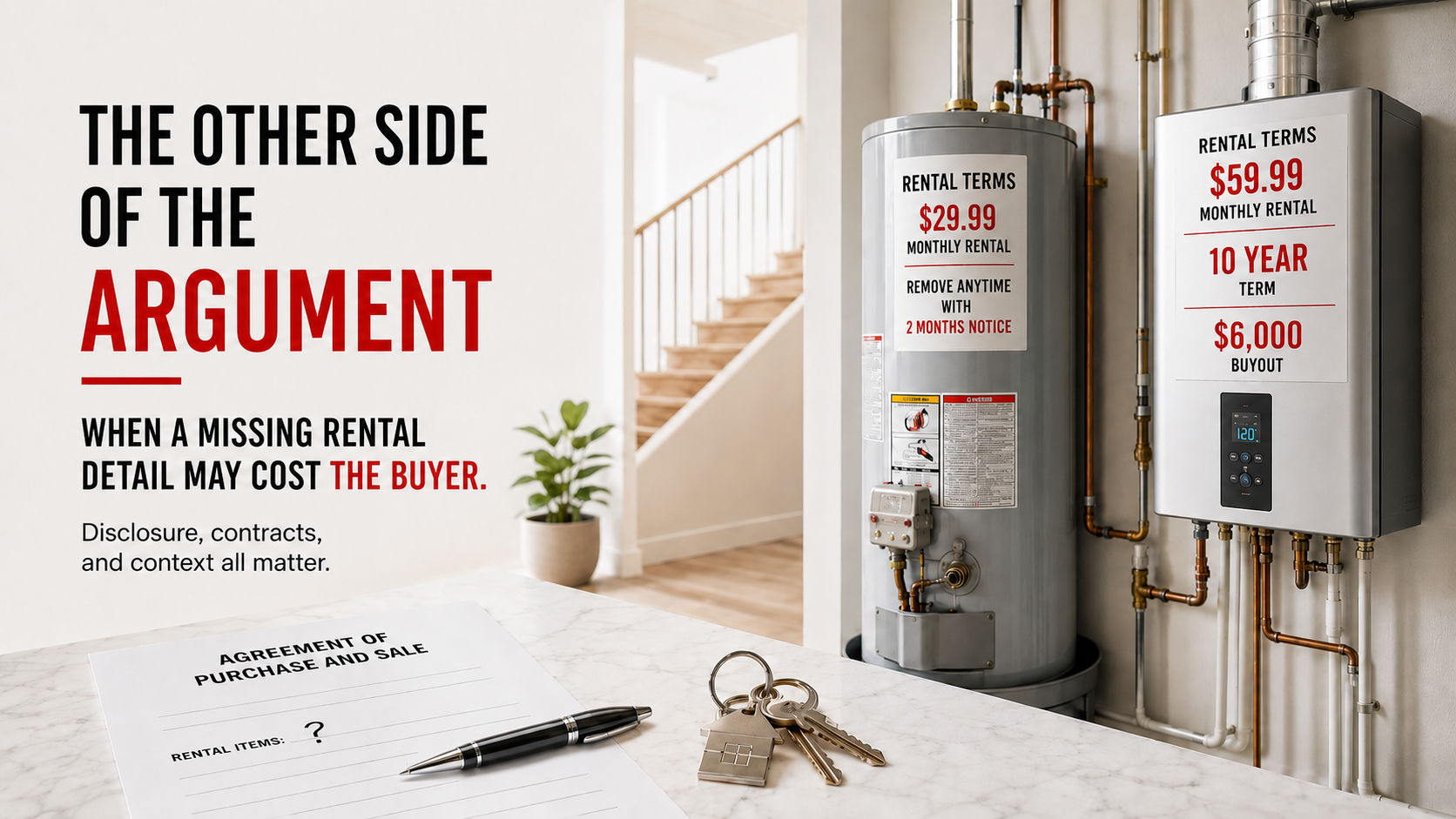
When a technical mistake still raises a fair question
Estimated read time: 5 minutes
There is another side to the water tank argument, and it deserves to be taken seriously.
A buyer should not be casually expected to assume a rental contract they did not agree to. That is not a small point. The contract matters. If the rental section of the Agreement of Purchase and Sale is blank, the buyer has a legitimate argument that they did not agree to take over any rental obligations.
And depending on the facts, that may matter a lot.
Not All Rental Items Are Equal
A basic hot water tank rental may be relatively modest. But newer tankless systems can be much more expensive. Some rental contracts have difficult buyout terms. Some buyers may have assumed the equipment was owned and planned to replace it, upgrade it, or move to an on-demand system after closing.
And if we move beyond water tanks, the issue becomes even more serious. A rented furnace or air conditioner can carry a much larger monthly cost and, in some cases, a very expensive buyout. Those contracts can create real long-term financial consequences for a buyer.
So the buyer’s side of the argument is not unreasonable. If a buyer did not agree to assume a rental contract, they are entitled to ask why they are being asked to take one on after the deal is firm.

The Missing Item Should Have Raised a Question
That said, there is another practical question that should not be ignored.
If the listing clearly said the hot water tank was a rental, but the Agreement of Purchase and Sale did not list it under rental items, that mismatch should have raised a question before the deal became firm.
Where was the item being dealt with?
If it was a rental, it should have been listed as a rental. If it was owned and included, that should have been understood or clarified. But if the listing says one thing and the contract says nothing, that is not something a careful agent should simply ignore.
Would We Be This Casual With Other Equipment?
This is where the “surprise” becomes more complicated.
Would the same thing happen with a furnace? If the listing suggested there was a rented furnace, but the Agreement of Purchase and Sale did not account for it as a rental or deal with it clearly in any other way, would everyone be so casual?
Probably not.
What about central air conditioning? What about a water softener? What about any other major mechanical system?
Most careful agents would see the inconsistency and ask the question before the offer became firm.
Hidden Obligation vs. Visible Inconsistency
That does not mean the buyer loses their legal position. The Agreement still matters.
But morally and practically, there is a difference between a hidden obligation and an inconsistency that was visible from the beginning. That distinction matters.
If a seller or listing agent failed to disclose a costly rental contract, that is a serious issue. If a buyer was led to believe a system was owned when it was not, that is a serious issue. If the rental contract is expensive, restrictive, or difficult to break, that is a serious issue.
In those cases, pushing back is not aggressive. It is necessary.
But that is not the same as a situation where the listing disclosed the rental, both sides had access to that information, and the error was that the rental item was missed in the paperwork.
That may still create a legal problem. But it is not necessarily a moral one of the same size.
The Real Question
An honest drafting error and a hidden financial burden are not the same thing. That is the centre of the issue.
The question is not simply:
Can the buyer enforce the contract?
Sometimes they can.
The better questions are:
- Was the buyer meaningfully misled?
- Was the rental properly disclosed?
- Was the obligation costly or unusual?
- Did the buyer make plans based on the belief that the item was owned?
- Did the buyer’s agent notice that the item appeared in the listing but disappeared from the contract?
- Was this a real financial surprise, or a technical mistake that should have been caught earlier?
Final Thought
That is where judgment comes in.
The goal is not to ignore the contract. The goal is to understand what the mistake actually means.
A good Realtor should protect their client from real risk. But a good Realtor should also be able to separate a meaningful problem from a paperwork error that everyone could have seen if they were paying attention.
That is not weakness.
That is judgment.
Before you go, there are related articles linked at the bottom of this article that explore the other side of this argument and a bigger question:
What kind of Realtor are you really hiring?
Because ultimately, this is not just about contracts.
It is about judgment.
